Go, Maybe or No: How to Decide Which Cleaning Bids Are Worth Your Time
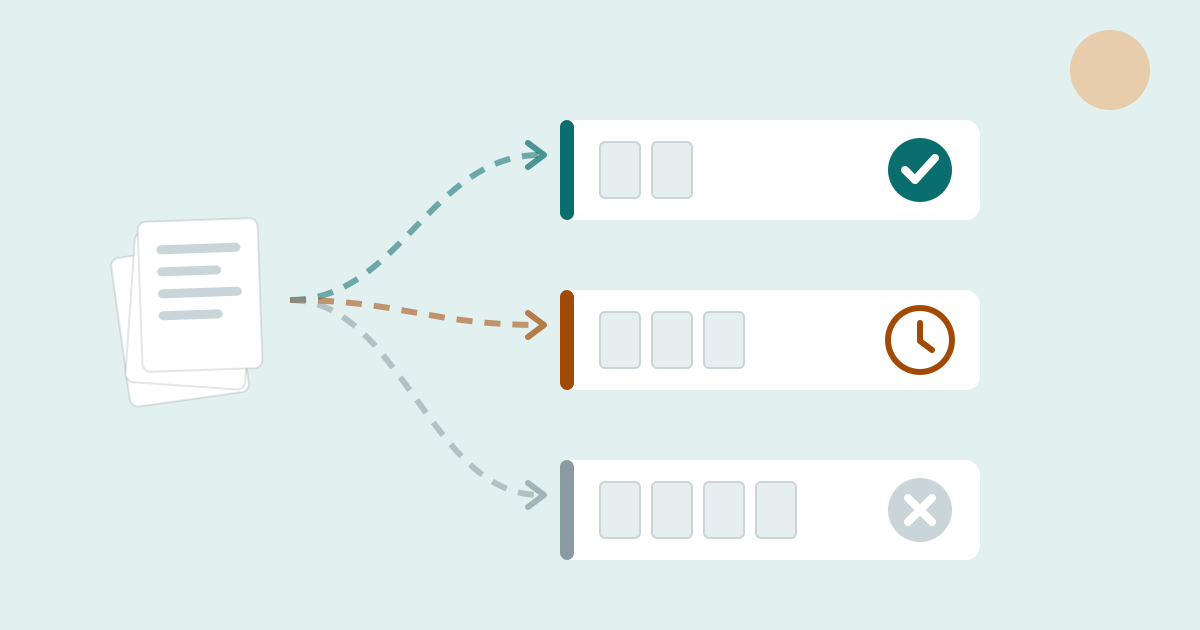
Short answer: Sort every public cleaning bid into Go, Maybe or No before you spend real time on it. First, run the knockout questions: if you can't meet a hard requirement, like a mandatory meeting, crew minimum, background check or insurance limit, it's a No. Then score the bids that survive on fit: distance, size, scope, competition, how the bid is scored, payment terms and contract length. Anything uncertain is a Maybe with a deadline. Get your questions answered before the agency's question cutoff, then make it a Go or a No.
In my article on how small cleaning companies win government contracts, I suggested a simple weekly routine: read the bids, then sort each one into Go, Maybe or No. That raises an obvious follow-up question. How do you actually decide?
That's a fair question, because it's the most important decision in the whole process. And most small contractors get it wrong in one of two ways.
Some bid on everything. They figure more bids means more wins. Instead they burn evenings on proposals they were never going to win, and they rush the ones they could have won.
Others bid on almost nothing. They open a 60-page solicitation, feel overwhelmed, and close it. They miss contracts that were a perfect fit.
Every bid you chase costs you something: hours reading specs, a morning at a pre-bid meeting, a site walk, pricing, forms, and sometimes a notary trip. That time comes out of running your crews and selling private accounts. A good bid/no-bid decision protects that time and points it at the jobs you can actually win.
Here's the method I'd use.
What Go, Maybe and No actually mean
The labels are simple. What matters is that each one comes with a next step.
| Label | What it means | What you do next |
|---|---|---|
| Go | You meet every requirement, the job fits your company, and you have a real shot at winning at a price you can live with. | Put every date on the calendar and block time to price and write it. |
| Maybe | It could be a fit, but one or two questions are still open. | Write down the open questions, and set a deadline to answer them. |
| No | You can't meet a requirement, or the job doesn't fit right now. | Note why, and save it for when the contract comes back up for rebid. |
Two rules make this work.
A Maybe always has a deadline. The deadline is the agency's question cutoff or the mandatory meeting date, whichever comes first. If you haven't resolved it by then, it becomes a No. Maybes that drift into the last week are how bids get rushed.
A No is never wasted. Public cleaning contracts get rebid on a cycle. The reason you said No today, like insurance limits that were too low, could be something you fix before the contract comes back around.
Step one: the knockout questions
Start with the questions that end the conversation. If the honest answer to any of these is no, and you can't fix it before the bid is due, the bid is a No. Don't score it, don't price it, don't fall in love with it.
- Can I make every mandatory date? Mandatory pre-bid meetings and site visits usually happen early, and missing one typically means your bid won't be accepted. If you can't be there, it's a No.
- Can I meet the staffing minimums? Crew counts, a full-time supervisor, minimum years in business. The last time Alachua County Public Schools bid its district custodial contract, a local company was rejected for not having three two-person crews available at all times.
- Can my whole crew pass the background checks? The City of Lake City's recent janitorial contract required FDLE/CJIS background checks for all staff. If key people can't clear, you can't staff the job.
- Do I carry the required insurance, or can I get it in time? Compare every limit in the solicitation with your certificate. If you're short, call your agent the same day. If the increase can't happen before the deadline, it's a No for now.
- Can I get bonding if it's required? Bid bonds and performance bonds aren't common on small cleaning contracts, but when they show up, they're a hard requirement.
- Am I registered and eligible? Vendor registration with the agency if required, local business tax receipts, E-Verify enrollment for Florida public contracts, and any certifications the bid asks for. (Here's where to register with each agency.)
- Do we actually do this work? If the scope is mostly floor stripping and you've never run a floor machine, or it's medical-grade cleaning and your crews don't have that training, be honest with yourself.
Most of these are covered in more depth in the fine print that knocks out cleaning bids. The point here is to run them first, in about 10 minutes, before you invest anything else.
Step two: the fit questions
A bid that survives the knockouts isn't automatically a Go. Now you're asking a different question: is this a job we can win, and do we want it? Here are the issues I'd weigh.
Distance and response time
How far is the building from your shop and from where your crews live? A contract an hour away means drive time on every visit, harder supervision, and slower response when something goes wrong. Close jobs are also where a local company has its biggest edge over out-of-state firms. Favor them.
Size: can you staff it without breaking something else?
Look at the cleaning schedule and the hours it will take. Could you cover it with your current crews, or would you need to hire? Hiring is fine, but be realistic about how fast you can find people who pass the background checks. Also ask how big this contract is compared with your whole business. One contract that suddenly becomes half your revenue is a risk if it ends.
Scope: does it play to your strengths?
Read the full scope, not just the title. "Janitorial services" can include day porters, floor care, carpet extraction, window washing, restroom supplies, or after-hours emergency calls. Bids that match what your crews already do well are easier to price accurately and easier to win.
Competition and the incumbent
Who holds the contract now, and how many companies bid last time? Bid results are usually public. A bid that drew 4 companies is a different game from one that drew 17. If the current holder has had complaints, that's an opening. If they've held it for years at a rock-bottom price, that's a warning.
How the bid is scored
Is it a low-bid award, where the lowest responsive, responsible bidder wins? Or a request for proposals scored on experience, approach and price? Low-bid contracts reward tight pricing. Scored proposals give a local company more ways to win: references, response time, supervision, small-business status. Know which game you're playing before you decide.
Can you win at a price you can live with?
Check what similar contracts sold for. If the going rate is well below what it costs you to do the work, that's a No, however much you want the job. (Here's how to price a bid using public bid results.)
Payment terms and cash flow
Public agencies pay reliably, but not instantly. Florida's Local Government Prompt Payment Act (Section 218.74) generally sets a 45-day payment deadline for non-construction purchases by local governments, with the clock starting when a proper invoice reaches the agency, as defined in Section 218.73. Late payments earn interest, but you have to ask for it. Either way, you're paying your crews every week or two. Make sure you can float payroll and supplies for the first couple of months.
Contract length and renewals
Many cleaning contracts run for a year or more, with renewal options. A good contract becomes steady revenue for years. A badly priced one becomes a long headache. Check whether prices can be adjusted at renewal, because wages and supply costs rarely go down.
Strategic value
Sometimes a small, modest-margin job is worth it because it gives you your first public reference, gets you in the door with an agency, or puts you in a building next to bigger work. That's a legitimate reason to say Go. Just be honest that it's an investment, not a windfall.
A simple scorecard you can copy
You don't need software for this. A notepad or a spreadsheet works fine. Once a bid passes every knockout question, give it 0, 1 or 2 points on each fit factor:
| Factor | 0 points | 1 point | 2 points |
|---|---|---|---|
| Distance | Over an hour away | 30 to 60 minutes | Under 30 minutes |
| Size | Would need to hire a full new crew | Some overtime or one new hire | Current crews can cover it |
| Scope | Mostly work you don't do | Some unfamiliar work | Right in your wheelhouse |
| Competition | Crowded field, entrenched incumbent | Unknown | Few bidders, or an incumbent with problems |
| Scoring method | Pure low bid, and you're not the low-cost shop | Unclear | Scored proposal that rewards local strengths |
| Price realism | Past prices are below your cost | Thin margin | Healthy margin at market prices |
| Cash flow | Would strain payroll | Tight but doable | Easy to float |
| Strategic value | None | Some | First reference, or a door into a new agency |
Add it up, out of 16:
- 11 to 16: Go. Calendar the dates and block time to write.
- 7 to 10: Maybe. Write down what's dragging the score down, and find out whether it can change.
- 6 or less: No. Note why, and watch for the rebid.
These cutoffs are a starting point, not a rule. Adjust them to your business. A company with spare crews can say Go more often, and one that's stretched thin should be pickier. What matters is that you're making the call the same way every week, instead of on gut feel at 10 p.m.
Turning a Maybe into a Go or a No
A Maybe isn't a decision. It's a short list of questions with a deadline. Here's how to work through the most common ones.
- "I'm not sure what the scope includes." Send a written question to the procurement contact before the question deadline. The answer usually comes back in an addendum that every bidder sees. Don't rely on a phone call. If it isn't in writing, it doesn't count.
- "I don't know if my insurance is high enough." Email the insurance section to your agent today and ask two things: can you meet it, and what will it cost? Price that cost into the bid.
- "I can't tell how big the job is." Go to the site visit, even if it's optional. Count restrooms, check the floors, ask about traffic and hours. Thirty minutes in the building tells you more than the specs ever will.
- "I don't know if I can be competitive." Look up what the contract sold for last time, and who bid. If last time's winning price is well below your cost, it's a No. If you're in range, it's a Go.
- "I'm not sure I can staff it." Talk to your crew leads before you decide, not after you win. Ask who would want the hours, and who could pass the background check.
- "I'm not sure it's worth it." Rescore it with what you've learned. If it still lands in the middle, make the call based on your capacity that month. A Maybe in a slow month can be a Go. The same Maybe in your busiest month is a No.
Whatever's still unanswered by the question deadline turns the Maybe into a No. That sounds harsh, but it protects you. A bid built on guesses is the most expensive kind to lose, and sometimes even more expensive to win.
Worked example: two real contracts, one made-up company
Let's run two recent North Central Florida contracts through the process. The contracts are real. The company is made up: a Gainesville cleaning business with two 2-person crews, decent insurance, no public contracts yet, and a cost of about $8 per 1,000 square feet per visit on office-type buildings.
Alachua County Public Schools District SWAT custodial services
The contract's final renewal ended September 30, 2026, so a rebid is expected. Last time, 24 companies were invited, only 4 bid, and an out-of-state firm won at $68,828 a year.
It looks tempting: few bidders, a local district, and an outside incumbent. But run the knockouts first. Last time, the specs required three two-person crews available at all times, and a local company was rejected for not having them.
Our example company has two crews. That's a No, unless the new solicitation changes the requirement. It's also a No worth writing down. If the company adds a third crew this year, this contract becomes one of its best targets on the next rebid.
City of Lake City janitorial for four municipal buildings
This one was awarded in September 2026: Public Safety, City Hall, Customer Service and IT/GIS, about 46,000 square feet in all, cleaned three times a week. The total came to $53,896 a year. It required a mandatory pre-proposal meeting and FDLE/CJIS background checks for all staff.
If our example company had seen it when it was posted:
Knockouts: The mandatory meeting is doable if the bid is spotted early. The CJIS checks are the open question. Every crew member, including fill-ins, has to clear. Maybe, until confirmed.
Fit score:
| Factor | Score | Why |
|---|---|---|
| Distance | 1 | Lake City is roughly 45 minutes to an hour from Gainesville |
| Size | 1 | Four buildings, three nights a week: a stretch for two crews, probably with overtime |
| Scope | 2 | Standard office and public-building cleaning |
| Competition | 1 | Bidder count unknown until the results are posted |
| Scoring method | 1 | A pre-proposal meeting suggests a scored proposal; confirm in the solicitation |
| Price realism | 1 | Awarded prices ran $6.83 to $9.04 per 1,000 sq ft per visit, so an $8 cost leaves a thin margin |
| Cash flow | 2 | About $4,500 a month in billings is easy to float for a company this size |
| Strategic value | 2 | A first public reference, and a door into a city government |
That's 11 out of 16: a Go, as long as everyone on the crew can pass the CJIS check. The two 1-point scores on size and price say go in with your eyes open. Price carefully, and plan the schedule before you commit to three nights a week an hour away.
Same company, same week, two very different answers. And neither took more than half an hour to reach.
Three traps to watch for
Bid fever. You've been to the site visit, you've read the specs twice, and you've started picturing the trucks in the parking lot. Now it's hard to say No, even when the numbers say you should. That's the sunk cost talking. Score the bid before you get attached, and rescore it honestly if something changes.
Bidding everything to "get your name out there." Agencies don't award contracts for effort. A rushed, half-priced bid doesn't build a reputation. It just takes time away from the bids you could win. Three strong bids a month beat ten weak ones.
Treating No as forever. Every No has a reason, and reasons change. Keep a simple list: the agency, the contract, when it's likely to come back up, and why you passed. Insurance too low? You can raise it. Not enough crews? You might have them next year. Market price too low? Watch what it sells for next time. The contracts you pass on today are the rebids you'll be ready for tomorrow.
How Rebid Ready speeds up the sort
The slowest part of Go, Maybe or No isn't the decision. It's digging the facts out of each solicitation. That's the part the Rebid Ready weekly digest is built to do for you.
Every Monday, subscribers get the public janitorial, floor and carpet bids from the cities, counties, school districts and colleges in North Central Florida, explained in plain English. Each listing puts the decision-making facts up front:
- The knockouts: mandatory pre-bid meetings and site visits with dates, crew minimums, background checks and location rules
- The deadlines: due dates and other key dates, so your Maybes have a clock
- The market: what similar contracts actually sold for, and how many companies bid, from public bid results
- The rebids: contracts coming back up, so your list of past No's turns into a list of future Go's
With that in hand, sorting a week's bids takes minutes, not an evening.
Frequently asked questions
What is a bid/no-bid decision?
A bid/no-bid decision is the choice, made early, about whether a public solicitation is worth the time and cost of preparing a bid. A simple way to make it is to sort each bid into Go, Maybe or No: knockout questions first, then a quick score on fit.
How do I decide whether to bid on a cleaning contract?
First check the knockouts: mandatory meetings, staffing minimums, background checks, insurance, bonding, registration, and whether you actually do the work. If you pass all of those, score the fit on distance, size, scope, competition, scoring method, price realism, cash flow and strategic value. Bid on the ones that score high.
What does Maybe mean in a Go/Maybe/No system?
Maybe means the bid could be a fit, but one or two questions are still open. Write the questions down, get answers in writing before the agency's question deadline, then make it a Go or a No. A Maybe that's still unanswered at the deadline becomes a No.
How many public bids should a small cleaning company submit?
There's no magic number. It depends on your crews, your time and how many good fits come up. Most small companies do better with a few well-prepared bids each month than with many rushed ones.
How long do Florida local governments take to pay contractors?
Florida's Local Government Prompt Payment Act generally sets a 45-day payment deadline for non-construction purchases, counted from when a proper invoice is received, under Sections 218.73 and 218.74, Florida Statutes. Late payments earn interest, but the vendor has to invoice for it. Plan your cash flow so you can cover payroll in the meantime.
Should I bid on a contract just to get experience?
Sometimes. A small contract can be worth a modest margin if it gives you your first public reference or a relationship with a new agency. Just don't bid below your real costs, and don't take on more than your crews can handle.
What should I do with bids I said No to?
Keep a list with the agency, the contract, when it's likely to be rebid, and why you passed. Many reasons, like insurance limits, crew size or registration, can be fixed before the contract comes back up.
Spend your time on the bids you can win
You can't bid on everything, and you shouldn't try. The companies that win public cleaning work consistently aren't the ones that bid the most. They're the ones that pick the right bids and put real effort into them.
Go, Maybe or No is how you pick. Knockouts first, so you never waste a minute on a bid you can't submit. A quick fit score, so the decision is the same every week. A deadline on every Maybe, so nothing gets rushed. And a running list of No's, so today's pass becomes next year's rebid.
If you clean commercial or public buildings in North Central Florida, try Rebid Ready free for two weeks. No credit card. Every Monday you'll get the public cleaning bids in your area with the knockouts, deadlines and past prices up front, so sorting your week takes minutes. After the trial, founding members pay $29 a month.
Start my free trial— Jeff, founder of Rebid Ready
Get new articles by email
One email each time I publish a new article. Just the articles, not the bid digest. Unsubscribe anytime.
Related: Florida's statewide janitorial contract is up for rebid: should a small cleaning company bid?
Disqualified before you're scored: the fine print that knocks out cleaning bids
How to price a government janitorial bid using public bid results
← More articles on the Rebid Ready blog
See what's in the Rebid Ready weekly digest
Sources
- Florida Statutes, Section 218.74: Procedures for calculation of payment due dates
- Florida Statutes, Section 218.73: Timely payment for nonconstruction services
- Examples from Alachua County Public Schools and the City of Lake City come from public bid records, as summarized in the Rebid Ready weekly digest. The example company and its costs are made up for illustration. Always confirm requirements in the official solicitation.